Central coordination
Light is a dominant cue for the brain’s central clock, which helps organize daily neural, hormonal and behavioral timing.
Biological Time
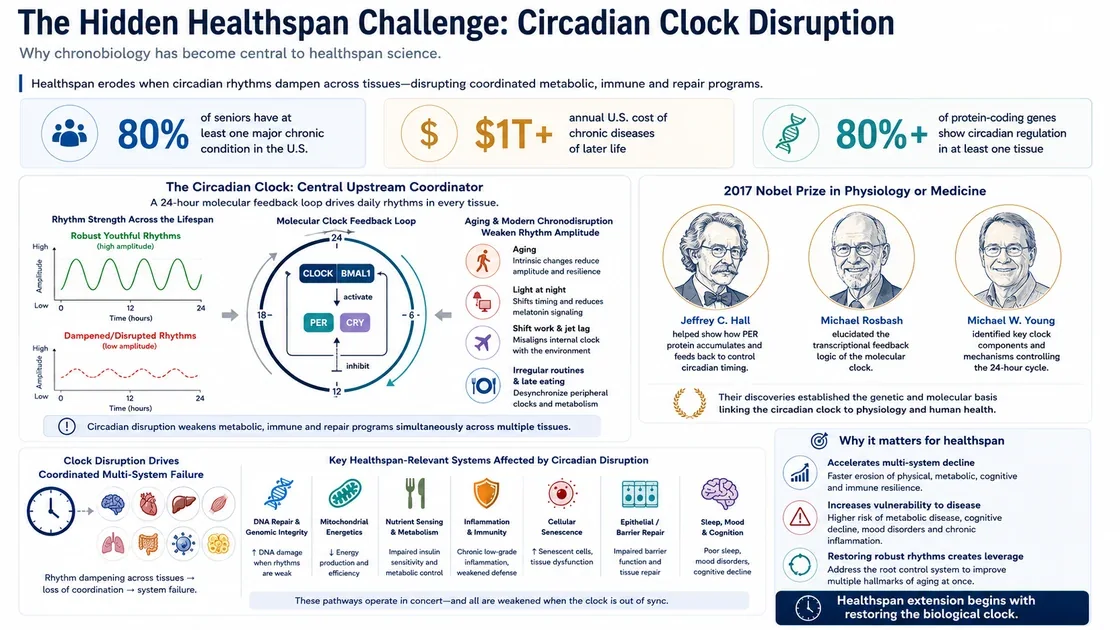
The circadian system is a network of central and peripheral oscillators. It is shaped by light, feeding, activity, temperature and hormones—and it cannot be understood from a single snapshot.
The coordination network
The light-responsive suprachiasmatic nucleus helps organize whole-body timing, while local oscillators in tissues respond to both central signals and local cues.
Light is a dominant cue for the brain’s central clock, which helps organize daily neural, hormonal and behavioral timing.
Liver, muscle, gut, skin and other tissues contain local oscillators influenced by meals, activity, temperature and circulating signals.
Healthspan research asks how strongly these clocks oscillate, how well they align and how resiliently they adapt to disruption.
Amplitude and phase
A rhythm can peak at the expected time yet be weak, or remain strong while occurring at a shifted time. DeepSense is specifically interested in amplitude enhancement, while preserving phase as a separate variable.
Illustrative only. A rhythm requires repeated measurements; a single snapshot cannot characterize amplitude or phase.
The difference between peak and trough—the strength or robustness of rhythmic expression.
The timing of a recurring event relative to external or internal time, such as when a peak occurs.
One value rarely describes a rhythm. Appropriate protocols sample repeatedly or use validated longitudinal proxies.
Everyday timing inputs
These cues can shape timing and alignment. They are general educational context, not individualized medical recommendations.
Morning and evening light exposure can influence central timing and sleep-wake patterns.
Feeding time provides a potent cue for metabolic and peripheral rhythms.
Activity timing interacts with sleep, metabolism and behavioral regularity.
Daily environmental and social patterns add signals that can reinforce—or confuse—internal timing.
The healthspan challenge
The current DeepSense visual below summarizes the systems hypothesis. The narrative creates a research opportunity; it does not imply that a single intervention reverses aging or every downstream pathway.
From timing biology to intervention
A useful next question is not simply “when should I take this?” but “what property of the rhythm is the intervention expected to change, in which tissue, and how will that be measured?”
They may be investigated for phase, amplitude, synchrony, duration, tissue-specific activation or time-dependent exposure. The label does not establish benefit on its own.
Continue to Chronobiotics
Your journey starts here
Explore how the membership translates a complex timing system into annual continuity, education and product rituals appropriate to each tier.